Community
Painstaking rescue of Kabul’s crumbling Bala Hissar fortress reveals 2,000 years of Afghan history
By Katherine Langford
Advertisement · Why this ad?
Marcus manages the day-to-day editorial workflow across all brands, coordinating coverage assignments and ensuring editorial standards are met. He previously served as city editor at the Pioneer Press and holds a degree in Political Science from Carleton College.
More from Marcus →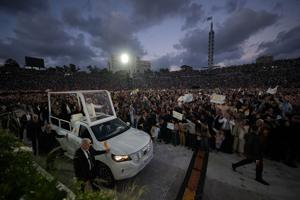
Thousands of pilgrims gathered in Florida, Uruguay, Sunday to mark the feast of the Virgin of the Thirty-three, as Pope Leo XIV concluded his visit to the nation and prepared for a potentially tense encounter with Argentine President Javier Milei. The Pope’s visit to Uruguay, his first in nearly four decades, aimed to reaffirm the Catholic Church's enduring role in a country that has, in recent decades, embraced secularism and even anticlerical sentiments. The Vatican views the trip as an opportunity to remind Uruguayans of the church’s historical significance, even as the nation has charted a course away from traditional religious influence.
Pope Leo XIV’s visit to Uruguay culminated in a commemoration of the feast of the Virgin of the Thirty-three in the city of Florida, north of Montevideo. This annual event draws thousands of pilgrims from across the country and beyond, all seeking to pay homage to the revered icon. The feast itself is deeply intertwined with Uruguay's national narrative. According to tradition, 33 independence patriots carried a small wooden icon of the Virgin Mary with them when declaring independence from the Brazilian empire on August 25, 1825. The image is believed to have been originally brought by indigenous Guaraní people, and its presence during the pivotal moment of independence cemented its place in Uruguayan folklore and religious practice. The Pope’s presence underscored the historical connection between Catholicism and Uruguay’s national identity. He is now traveling to Argentina, the second leg of a three-nation South American tour, where he is expected to meet with President Milei. The visit comes just weeks after Pope Leo XIV underwent surgery on October 13 to remove a cancerous tumor from his lung, though he has appeared in good health throughout the trip, singing, greeting crowds, and maintaining a demanding schedule.
The significance of Pope Leo XIV’s visit to Uruguay cannot be overstated. Uruguay's history is marked by periods of intense religious devotion followed by waves of secularization and even overt hostility towards the Catholic Church. The 1917 Constitution, for example, formally separated church and state, and subsequent governments often pursued policies that actively discouraged religious influence in public life. Despite this, Catholicism remains a significant cultural force in Uruguay, shaping traditions, values, and social structures. By visiting Florida and participating in the Virgin of the Thirty-three feast, Pope Leo XIV sought to acknowledge this complex history and reaffirm the church’s continued relevance in contemporary Uruguayan society.
The Pope’s decision to proceed with the South American tour despite his recent health challenges highlights his commitment to engaging with the region. Luis Bahamondes, a professor at the Center for Judaic Studies at the University of Chile, noted that Leo’s willingness to confront potential conflict and offer a respected voice reinforces his image as a broader political leader. His appearance in Argentina is expected to be politically charged, given the tensions between the Catholic Church and President Milei’s austerity measures.
Prior to his departure from Uruguay, Pope Leo XIV underscored the importance of the church's presence in the country's identity, despite its secular trajectory. The visit served as a reminder of the enduring faith of many Uruguayans, even as the nation has embraced a more secular culture. The Pope’s schedule has been rigorous, with appearances often extending past midnight Rome time, demonstrating his dedication to his mission.
The encounter between Pope Leo XIV and President Milei is anticipated to be a delicate moment, particularly given Milei’s controversial economic policies. The president’s sweeping spending cuts have drawn sharp criticism from Argentine church leaders, who argue that they disproportionately impact the nation’s most vulnerable citizens. For example, Argentina’s healthcare budget has been slashed by 48% in real terms since Milei took office in December 2023. Planned cuts to the public university system, a source of national pride, have sparked protests. The cuts represent a significant shift in Argentina's social safety net, which has historically been a cornerstone of the nation’s identity and a source of stability during periods of economic turmoil.
The economic hardship experienced by many Argentines is a significant factor in the anticipated tension between the Pope and the President. Official data indicates that poverty in Argentina reached 32.3% of the population during the first half of 2026, impacting approximately 15 million people. Milei’s embrace of artificial intelligence investment and deregulation, coupled with his austerity measures, has further strained relations with the church, which has traditionally advocated for the poor and marginalized. The church has consistently voiced concerns about the impact of these policies on vulnerable populations, arguing that they exacerbate inequality and undermine social cohesion. Milei’s policies represent a radical departure from previous administrations, which often prioritized social spending and government intervention in the economy.
Beyond the immediate economic impact, Milei’s policies have also sparked broader concerns about the direction of Argentina’s political and social landscape. His embrace of libertarian ideology and his often-combative rhetoric have polarized the nation and heightened political tensions. The Pope’s stance on AI – cautioning against its unchecked development – adds another layer to the potential for disagreement. His concerns center on the ethical implications of AI, the potential for job displacement, and the need for international cooperation to ensure responsible development and deployment.
Pope Leo XIV’s visit to Argentina is seen as a completion of unfinished business left by his predecessor, Pope Francis. The Argentine Jesuit, the former archbishop of Buenos Aires, never returned home during his 12-year pontificate, confounding friends and foes alike. David Lantigua, a theology professor and faculty fellow at the University of Notre Dame’s Kellogg Institute, noted the complex legacy of Pope Francis in Argentina, where his tenure as archbishop of Buenos Aires was sometimes divisive. Bergoglio was a slum priest who advocated for the poorest and most marginalized — the sector of Argentines who have been feeling Milei’s social spending cuts the most. His advocacy for social justice and his focus on the plight of the poor resonated deeply with many Argentines, but also drew criticism from those who favored more conservative approaches.
Francis’s absence from Argentina during his pontificate was a source of speculation and disappointment for many. His decision not to return was interpreted by some as a sign of his discomfort with the political climate in Argentina, while others saw it as a reflection of his broader commitment to universal outreach. Leo XIV’s visit, therefore, represents an opportunity to bridge the gap between the Argentine people and the papacy, and to address some of the unresolved issues that have arisen during Francis’s tenure.
It’s striking that Pope Leo XIV is undertaking this journey, especially so soon after his surgery. It speaks to a deep commitment not just to the faith, but to the people of Latin America, particularly those struggling under economic hardship. The confrontation with President Milei’s policies isn’t about politics; it's about the fundamental dignity of human life and the responsibility of leaders to care for the vulnerable. The cuts to healthcare and education are a symptom of a larger societal problem—a willingness to sacrifice long-term well-being for short-term gains, often at the expense of families. We see this pattern repeated across the Western world, and it’s heartening to see a moral voice, even from the Vatican, standing up for what’s right. It’s a reminder that true progress isn't measured in GDP but in the strength of our communities and the well-being of our children.
Residents seeking assistance or information related to the challenges facing Argentina can find resources through the following organizations:
For information about Pope Leo XIV’s visit and the Vatican’s activities, please visit the Vatican website.
The Pope’s visit to Argentina serves as a poignant reminder of the church’s enduring commitment to social justice and the importance of advocating for the needs of the most vulnerable. It remains to be seen how President Milei will respond to the Pope’s message, but the encounter is sure to be a defining moment in the relationship between the Argentine government and the Catholic Church.
By Katherine Langford
By Marcus Chen

By Marcus Chen
By Marcus Chen